


Russian Virtual Computer Museum. → The SM series of minicomputers → The Family of Mini-computers SM (SM computers). Part I
The Family of Mini-computers SM (SM computers). Part I
Home → SM EVM → The Family of Mini-computers SM (SM computers)
Dr. G.A. Egorov, N.L.Prokhorov
Translated by Alexander Nitusov.
In 1974, Intergovernmental Commission on Cooperation between the socialist countries in the field of Computing Technology (ICCCT), decided to appoint Moscow research and engineering INstitute of Electronic COntrol Machinery (INECOM) as the parent enterprise on development of minicomputer family SM. B.N. Naumov - director of the INECOM, was appointed the chief designer of the SM computers. Dr. N.L. Prokhorov replaced him as new INECOM director in 1984. He was also appointed the SM chief designer in the same year.
More than thirty research institutes and industrial enterprises from the USSR, Bulgaria, Hungary, GDR, Cuba, Poland, Rumania and Czechoslovakia were engaged in that program.
Minicomputer SM was designed and composed as aggregate system of computer hard- and soft-ware, which also included methodic, regulatory and maintenance support, and applied standards. As the result, this complex provided rational compatibility and unification of various systemic, architectural, circuitry and design solutions.
Proposed basic principles, technologies and standards for SM minicomputers, encompassed all aspects of their components, units, devices and software systems unification, for all SM models and complexes based on them. Availability of national technologies and actual potential of industrial efficiency were also taken into account. All that made possible establishing of large-volume production and development of applied systems based on new minicomputers SM.
Regulatory framework for SM computers was developed in the beginning of the project by the Council of Chief Designers (CCD SM). Without these regulations it would be impossible to establish large-scale industrial manufacturing of the SM computers at various enterprises located in different countries.
Several general principles were adopted as the basic ones for development of minicomputers SM, the most important of them were:
- ensuring continuity of new software at applications to earlier models of computers and computer-based control complexes, such as Model M: M-400, (SM-3, SM-4, SM-1300, SM -1420), M-5000, (SM-1600), M-6000/7000, (SM-1, SM-2, M-1210, SM-1634), “Mir”(SM-1410);
- creation of systems with sharing of functions, using both universal and specialized processors of SM computers;
- large-scale usage of microprogram control for implementation of the processors' and controllers' basic functions;
- usage of programmable controllers of peripheral equipment
- forming of common -for a number of models- nomenclature of peripheral equipment by the use of standard interfaces of peripheral devices and devices for object communication;
- developed range of data transmission adapters for interfacing SM computers with communication lines according to international standards
- means of SM computers interfacing with computers of ES series in heterogeneous systems/networks (SM computers' terminals emulation on ES computers, as an example).
- construction of problem-oriented complexes, produced by industry and based on SM models: specified control computer complexes (CCC) supplied by factories according to customers' specifications; measuring and computing complexes (MCC) with CAMAC equipment or Aggregate Complexes of Electrical Measuring Technical means (ACEMT); automated workstations for computer-aided design systems (CADS) in radio and electronics, engineering and construction fields;
- unified components for all minicomputers SM, to meet standards of the International Electrotechnical Commission.
Development of mini computers SM was carried out along two architectural lines..
The first architectural line included wide range of control computing systems based on micro-computers of SM-1800 family, built on the trunk-modular principle.
The first models of the line were 8 – bit micro-computers (microprocessor KR508), built on the trunk-modular principle with internal interface I-41 (Multibus).
In 1987 development of computer SM-1810 (microprocessor K1810VM86) - the first 16-bit model of the family was completed and its serial production began. SM-1810 also used interface I-41, which made it possible to use in it the peripheral modules and devices of SM-1800 (the previous model). In total, six modifications of general-purpose SM-1810 and four special models for industrial applications - SM-1814, were produced.
In 1990, development of the 32-bit computing complex SM-1820, based on microprocessor Intel-803, was completed.
Altogether 26 modifications of SM-1800 family were developed and produced within the 1977-1990 period.
Wide range of external devices, such as devices for communication with object, network hard- and software means, adapters of various interfaces (C-2, ES-422, IRPS (interface serial radial), ILPS (Local Area Network Interface -Industrial), BITBUS, etc.) was developed for this SM computers line.
Trunk-modular principle of architecture was adopted and implemented in all developments of the SM-1800 family. That allowed almost continuously ensure the process of evolutionary development of all modules of the family, both in terms of productivity increasing, and meeting functional requirements in the field of application.
The system software of SM-1800 family included instrumental operating systems (DOS-1800, DOS-1810), executive real-time operating systems (OS SPF-1810, BOS-1810), operating systems for general-purpose (Micros-86, Demos, MDOS).
Possibility of using a wide range of hardware and software, mass-produced for the SM-1800 computer family, allowed to meet the requirements of such application fields as APCS (automated process control system), ASNI (computer-assisted research system), GPS (Global Positioning System), automated economic and textual information processing systems, etc.
Serial production of microcomputers family SM-1800 was performed by Kiev (Ukraine) Production Association (PA) “Electronmach”, PA “Control computers producing plant (named after K.N.Rudnev)” in town of Orel, and PA “Elva” in Tbilisi (Republic Georgia).
The second architectural line of SM computers was represented with line of software compatible mini-computers having different performance. Low-end-models of that line were 16-bit computers (SM-3, SM-4, SM-1300, SM-1420) based on system interface “Common Bus” (CB).
Computing complex SM-1425, with 22-bit trunk parallel system interface (TPI), was further development of SM-1420. Its architectural capabilities were more advanced 32-bit mini-computers of SM-1700 family, with interface CB, and SM-1702 with interface TPI, took special place in this line. Architecture of that family supported virtual memory, soft- and hard-ware compatibility with16-bit models of minicomputers and well-developed diagnostic system.
All models of the second architectural line were produced in series by Kiev production association (PA) “Electronmach”, “Energopribor” plant of Moscow and Lithuanian PA “Sigma” in town of Vilnius. They all were taking active part in development during the whole project period.
Controllers, peripheral devices and special processors providing significant increasing of computer performance for given class of problems to be solved, occupied big part of the SM production range.
Most famous of them was the special processor for Fourier fast transforms (FFT-SM), developed and produced in cooperation with the Institute of Radio Engineering and Electronic of the USSR Academy of Sciences (AS USSR). Fourier processor was implemented for processing of the radar images of the planet Venus surface.
That large-scale research, performed by the AS USSR under guidance of the Academy member academician Vladimir A. Kotelnikov, needed computing power equivalent to supercomputers which were not available at that time. However, the problem was solved with the use of mini-computer extended with special Fourier processor.
Logic simulation processor, which itself was a special computer for accelerated simulation of digital circuits, is another notable device. The scope of this special processor application - computer aided (automated) design systems for VLSI (Very Large Scale Integration). Original streaming (pipeline) architecture of this special processor provided, in average, 1000 times acceleration of modelling, in comparison with general-purpose computers.
Significant results were achieved during development of memory devices based on cylindrically-shaped magnetic domains (magnetic bubble memory). Those work was carried out under the leadership of V.K. Raev. Results of the work notably influenced development of fundamental science of domain boundaries microstructure, and diversified technologies for creating information storage devices on magnetic domains of micron and sub-micron sizes.
Minicomputer SM-1800
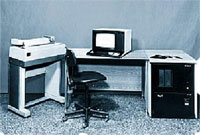
Pic.1. SM-1803
Micro-computer SM-1800,developed in 1979, was 8-bit n-channel MOS IC based aggregated system, for control of production processes and units, automation of laboratory measurements and experiments, performing computations, data preparation, for text files and tabular information processing, programming, learning and training.
Computer constructive realisation options depended on ways of its usage in production rooms, laboratories, offices, or its direct integration into units. Structural and functional composition – variable, determined by the customer's needs.
Main technical characteristics
|
Command system |
Determined by the microprocessor architecture KR580IK80A |
|
Clock frequency |
2 MHz |
|
Word length |
8 bit |
|
Command execution time / Run time |
2 to 8,5 µs |
|
Maximum memory capacity (arbitrary combination of RAM and ROM) |
64 KB |
|
Maximum number of addressable ports |
|
|
Input ports |
256 |
|
Output ports |
256 |
|
Number of interrupt levels |
8 |
|
System interface |
• I-40, I-41 (Multibus) |
External peripherals:
- floppy disk drive Plx45D5M;
- video display terminal ВТА-2000-30;
- printer DZM-180 or DARO-1156;
- punched tape input/output device SM-6204.
Object communication devices (have galvanic isolation):
- Discrete
- analog.
Communication means:
- “Common bus”;
- Radial parallel interface (IRP);
- Radial serial interface (IRS);
- Joint J-2.
Structural basis
SM-1800 consists of basic computer (BC), and set of external device modules, located inside cabinet, stand and operator's desk.
Basic computer (BC) can be made in three modifications:
BC SM-1801 consists of mounting block, central processor module (CPM), and system control module (SCM).
SM-1801 is used in frame design as micro-computer, for mounting in it installations produced by customer. Nomenclature of modules is specified by the customer's order.
Basic Computer (BC) SM-1802 integrates Autonomous Control Unit (ACU), in instrument version, with a front panel, CPM and SCM, and also is intended for built-in applications.
Basic Computer (BC) SM-1803 is mounted in stand or in a cabinet, provided with external devices and software. It is made as nine standard complexes, different in structural layout and sets of soft- and hardware means.
Open and accessible architectural structure of SM-1803 computer allowed to easily include in it additional modules and devices, designed and produced by users themselves.
SM-1803 was also the basic computer for later produced ARM-2-05 /(AWP-2-05) – automated workstation for microprocessor systems developers. This AW incorporated in-circuit emulator for microprocessor-based control systems of series K-580 and K-589.
“Big Computer” (BC) SM-1804 was produced later. It was a “Heavy-duty computer”, designed for environment which imposed increased demands to its performance and reliability. Special sealed cabinet was designed for this model.
Computers SM-1800 were serially produced, in various modifications, since 1980, by “Control Computers” factory (VUM) of the Kiev Production Association (PA) “Electronmach”. Later, model SM-1803 was also produced by PA “Elva” in town of Tbilisi (republic Georgia).
Computer SM-1803 was in serial production until 1990. A total of about 12 thousand complexes were produced.
Besides that, many other organisations received project documentation from INECOM, on various conditions, and themselves manufactured numerous controlling systems, built-in various devices and installations.
Main designers of this series were: A.N. Shkamarda, N.D. Kabanov, V.I. Guskov, V.S. Kravchenko, V.I. Glukhov, S.G. Khodonovich, A.Y. Sokolov, V.V. Grevtsov, Y.V. Nifontov.
Computer SM-1810
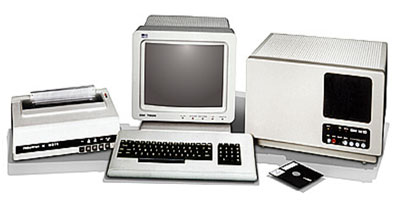
Pic. 2 SM-1810 – desk-top modification
SM-1810 and SM-1814 (SM-1810 designed for industrial applications) – further development of SM-1800 architectural line, based on 16-bit microprocessor K1810BM86 and system interface I-41.
SM-1810 was designed in 1986. These complexes posses higher technical characteristics for performance, addressable memory capacity, data bit depth, sharp decrease of material consumption, improved aesthetic and ergonomic qualities.
SM-1810 has a high level of compatibility with 8-bit models of SM-1800 family. These computers ensure usage of, earlier accumulated, applied software, and hardware compatibility with a wide range of modules and devices of SM-1800 family.
MCP-16 – central processor module, based on 16-bit microprocessor K1810BM86, was specially made for SM-1810. Also a new system control module, new module for operating memory (RAM) with capacity of 256 KB (later – 1 MB), controllers for 2.25-inch floppy disk drives, hard- and Winchester type disks drives were designed.
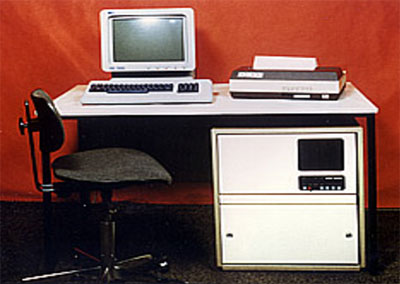
Pic. 3. SM-1810 – pedestal version
Modified processor module MCP-1 (МЦП-1), based on K580IK80, was designed to provide compatibility with SM-1803 on applied software level.
Nomenclature of modules and devices for SM-1800 family notably expanded. They could be used both in 8- and 16-bit models of the family. Interface modules for network X.25 protocol, interface for linear serial communication – ILSC, and input device for low-level analog signals were designed.
SM-1810 was designed with more modern and compact cases, in three variants: desk-top, rack-mounted and pedestal. It also received new power supply sources.
Most of new modules for SM-1810 were intellectual devices. They incorporated microprocessors and internal software.
Some imported/foreign large scale integrated circuits (LSIC) were implemented in case producing of their analogues was planned by Soviet industry. Some of the most complex modules were made on 4-layer printed circuit boards. The density of placement of electronic components on the board has been increased (up to 120 16-pin DIP packages of Integrated Microcircuits on the board 220x233,3 mm).
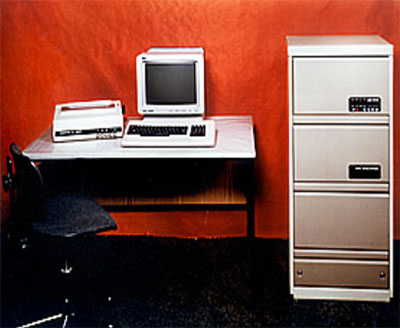
Pic. 4. SM-1810 – rack version
Performance of complexes SM-1810 was approximately five times higher as of SM-1800. Software of computers SM-1810 provided their user extensive possibilities for building both real-time systems (SM-1810 pedestal version) and instrumental ones, and also for implementation of numerous applied program packages
Computing complexes SM-1810 and SM-1814 possess highly developed peripheral devices such as adapters for various interfaces, network modules and modules for communication with objects. All this makes possible building of flexible management/control systems on their basis.
Computing complexes are designed to collect, process and store information, control of technological processes with continuous discrete production processes in the metallurgical, energy, automotive, oil and gas industries, etc.
General technical specifications:
System interface I-41
Data width, bit 16; 8
Address width, bit 24
Maximum addressable memory capacity
Random Access Memory (RAM) 1 MB
Read-only memory (ROM) 1 MB
Number of requesters (masters) served by the priority arbitration scheme 16
Priority arbitration parallel, cyclic
Number of addressable ports
input - 65 536
output - 65 536
Execution time of operations on 16-bit numbers in microprocessor К1810ВМ86, - mc:
register–register 0,4
addition 0,6
multiplication 30,6
division 37,8
microprocessor generator clock frequency 5 MHz
number of interrupt requests up to 65
The system interface I-41 of SM 1810 complexes, compared to the system interface of SM- 1800, has additional functionality and larger number of address buses.
Nomenclature of peripheral devices includes hardware fo connection with the following interfaces and joints: Common bus, I-41, IRPR-M (CENTRONICS), IRPS (interface serial radial), ILPS (Local Area Network Interface -Industrial), S1-FL, S1-TG, S2.
Component base of the complexes includes IMC (Integrated Micro Circuit) with higher integration degree, and also digital and analogue IMC with medium-scale integration. Mass production of SM-1810, in various configurations for end users was carried out by PA “Electronmach” (Kiev), Plant for Control Computers (named after Rudnev) in town Orel, and PA “Elva” in town Tbilisi (republic Georgia).
A total of about 18 thousand SM-1810 complexes were produced in Kyiv, Orel, and Tbilisi between 1986 and 1993.
N.L. Prokhorov, A.N. Shkamarda and N.D. Kabanov, as chief designers of SM-1810, were awarded the Premium of the USSR Council of Ministers in 1987.
Main designers were: - A.N. Shkamarda, N.D. Kabanov, V.I. Guskov, I.I. Babanov, V.I. Glukhov, S.G. Khodonovich, O.M. Shatokhin, V.S. Kravhenko, V.V. Grevtsev, Y.V. Nifontov
